The Game Without the Ball: What 7,705 Matches of Tracking Data Tell Us About Modern Football Tactics
Football is usually remembered through actions on the ball: a pass that breaks a line, a dribble past a defender, a save or a finish. Yet most of the match is shaped by players who are not touching the ball at all. Their positioning decides whether a passing lane exists, whether a defender must leave a zone, whether a counterattack has space to develop and whether a press can close around the next receiver. A 2026 scoping review by Francesco Esposito, Maurizio Bertollo, Dario Pompa, Maria Angonese and Marco Beato brought together research that has tried to measure this largely hidden part of elite football. Published in Science and Medicine in Football on 4 August 2026, the review screened 4,283 records and retained 32 peer-reviewed studies. Across those studies, researchers had analysed 7,705 matches using positional tracking alongside event data. The result is not a single formula for winning football. It is a much clearer picture of why modern tactics depend on space, timing, collective movement and context rather than on possession numbers, running totals or formations alone.
Why the Game Without the Ball Has Become Measurable
The figure of 7,705 matches needs to be read correctly. Esposito and his colleagues did not receive one uniform database containing that many games and then run the same test across every match. Their review combined 32 separate studies, with samples ranging from individual matches to research covering more than 4,000 games. The studies also used different competitions, definitions and analytical methods. That makes the total valuable as a map of what researchers have studied, but it does not turn every finding into a universal law. The review itself stresses this methodological variety. Its strongest message is therefore broader: off-ball behaviour has moved from being something coaches mainly described through video and experience to something that can also be observed repeatedly in positional data. That change matters because football’s decisive structures often appear several seconds before an obvious on-ball action. A winger may pin a full-back without receiving a pass, a midfielder may block a counterattacking lane while his team attacks, or a forward may pull one centre-back away to create space for someone else.
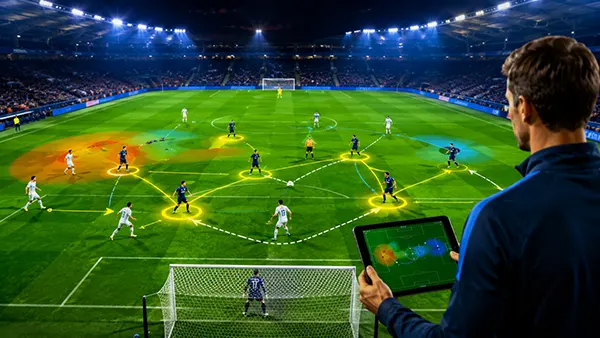
Tracking systems make those actions visible by recording where players and the ball are located many times each second. In the studies reviewed in 2026, 25 Hz was the most common sampling frequency, meaning that a system can register positional information 25 times per second. The practical value is not the frequency itself but the sequence it creates. Instead of seeing only that a pass was completed, analysts can examine the positions around the passer, the receiver, nearby defenders and supporting teammates before, during and after the action. Event data still matters because it identifies moments such as passes, shots, ball recoveries and possession changes. When event and tracking data are aligned, an analyst can ask a more useful tactical question: what movement created the conditions for the event? That shift is central to current football analysis because many players influence an action without being listed in the conventional statistical record.
The review also shows why off-ball analysis cannot be reduced to one number. Researchers have examined behaviour at three broad levels: the individual player, smaller groups of players and the whole team. At individual level, the focus might be on whether an attacker creates separation from a marker. At group level, it can be the relationship between a back line and the midfielders protecting space ahead of it. At team level, analysts may measure width, depth, compactness or how much of the pitch each side can reach first. These levels answer different questions, and none should automatically replace the others. A team can appear compact as a whole while one important passing lane is open. A player can cover a large distance at high speed without improving the attack. A defence can have numerical superiority but still be poorly positioned. The tracking literature increasingly points towards the same practical principle: movement becomes meaningful only when it is linked to where it happens, when it happens, what the ball is doing and what opponents are able to do next.
From Coordinates to Tactical Meaning
One useful example is defensive pressure. Traditional match data may record that a player received a pass and either kept or lost the ball, but it does not fully describe how difficult the reception was. A 2022 study led by Mat Herold examined 22 matches involving the German national team, including 25,418 passes and 1,411 high-intensity off-ball actions. The researchers modelled the pressure on receivers and used it to study how attacking players created separation from defenders. They found a clear relationship between higher pressure and lower pass-completion rates. For a coach, the idea is straightforward even if the calculation behind it is complex: the same pass can be a very different action depending on whether the receiver has time to turn, is being closed from several directions or has created an extra metre through a well-timed movement. Tracking data provides a way to attach that context to the event rather than treating every reception as tactically equivalent.
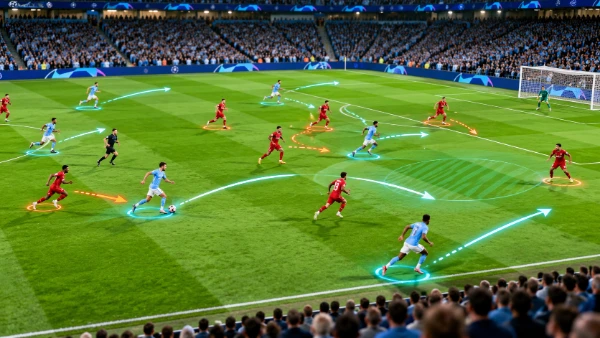
Space can also be measured as a relationship rather than as an empty patch of grass. Analysts can estimate which player is best placed to reach a given area first, how far teammates are spread from one another or how a team’s shape changes as the ball moves. These measures help describe familiar coaching ideas such as stretching a defence, locking the centre, protecting the space behind an attack and moving as a unit. What changes is the ability to test those ideas across hundreds or thousands of sequences rather than relying on a handful of memorable clips. The 2026 review found that researchers have used a wide variety of such measures, but it also warned that definitions are inconsistent. Two papers can both discuss “space” or “pressure” while calculating them differently. For readers, that is an important safeguard: a sophisticated graphic or a precise decimal does not automatically mean that the underlying concept has been settled.
This is why the most useful role of tracking data is not to replace tactical language but to make that language more precise. In a separate 2026 paper, Esposito and colleagues proposed a framework that classifies off-ball behaviour by possession context and purpose, by whether the unit being studied is an individual, a group or a team, by the performance dimension involved, and by the type of movement such as positioning, manoeuvring or high-intensity running. The value of such a framework is practical. Saying that a player “worked hard off the ball” is vague. Saying that a winger repeatedly made in-possession runs behind the last line, or that two midfielders protected central space during attacking possessions, gives coaches and players something concrete to review. The emerging research therefore supports a more disciplined way of talking about tactics: first define the behaviour, then measure it in the relevant match context, and only then judge whether it helped the team.
What 7,705 Matches Tell Us About Attacking Movement
One of the clearest themes in recent research is that attacking quality depends on how players organise space around the ball, not simply on how many players occupy advanced positions. A 2024 study by Dominik Raabe and colleagues analysed 128,187 attacking sequences from 306 elite men’s matches. The researchers looked at how teammates formed passing structures and how their positioning affected defenders. Successful attacks were associated with larger triangles between teammates, especially near the ball, rather than with a higher total number of triangles. They also found that successful attacks more often involved players occupying positions that tied up defenders and left other teammates free. Put into ordinary football language, structure matters more than crowding an area. Three players can stand in the same zone and offer very little if their angles are poor. The same three players, separated at useful distances and on different lines, can force defenders to choose between protecting the ball, covering a runner and guarding a passing lane.
Runs behind the defensive line tell a similar story about context. Thomas Thönnessen and colleagues analysed more than 4,600 runs in behind from 54 Bundesliga matches from the 2018/19 season. At first, the total number of such runs was related to success, performance and goals. However, that relationship disappeared when the researchers adjusted for ball possession. Teams that have the ball more often naturally have more chances to make attacking runs. The stronger signal came from runs with a clearer tactical context, particularly runs into critical areas and runs accompanied by a forward pass. Those remained related to performance, team strength and goals even after possession was considered. This is a useful warning against raw counting. Telling a striker to make more runs is not the same as improving movement. The relevant questions are where the run starts, which space it attacks, what the passer can see, how the defensive line is positioned and whether the movement changes the next action.
A large 2024 study of Major League Soccer adds another layer. Sam Gregory and colleagues used full event and tracking data from all 475 matches of the 2022 MLS regular season and identified 628,186 high-speed runs, an average of more than 1,300 per match. They then estimated how the in-possession team’s probability of scoring changed during those runs. Higher-value runs were associated with greater speed and acceleration and with more direct, less curved paths. The study also found that higher-value moments tended to involve several teammates making high-intensity runs at the same time. That does not prove that simultaneous running caused the increase in scoring probability; the authors explicitly note the problem of attributing team value to a single runner. Even so, the pattern matters. The attack is often more dangerous when several movements happen together, because one player can stretch the line, another can attack the box and a third can arrive as a support option.
The Best Run May Never Receive the Ball
The hardest contribution to capture is often the run that is not rewarded with a pass. Consider a forward who starts between centre-back and full-back, accelerates towards the channel and pulls the centre-back five metres away from the middle. The ball may then be played to a midfielder arriving through the space that has just opened. Traditional event data credits the passer and receiver, while the forward may register nothing beyond distance covered. Yet the tactical value of the move may depend on that first run. Tracking data allows analysts to reconstruct the full picture: the defender’s movement, the space created, the timing of the supporting run and the resulting change in the attacking team’s options. This does not mean every decoy run should receive a numerical score. It means analysts can identify and compare patterns that were previously easy to overlook when reviewing only touches, passes and shots.
That distinction changes how attacking players can be evaluated. A winger who repeatedly receives the ball may look more involved than a winger who spends much of the match stretching the back line, pinning a defender and creating an inside lane for a midfielder. A striker may have few touches but still influence the defence by threatening space behind it. A full-back may make an overlap mainly to drag an opponent away rather than to receive a pass. The 2026 body of research supports judging these actions within the team’s tactical intention. The key question is not “Did the player get the ball?” but “What changed because the player moved?” Sometimes the answer will be a new passing lane, a defender forced to turn, an extra metre for the ball carrier or a temporary numerical advantage somewhere else. Those effects are easier to discuss when video and tracking information are reviewed together.
For recruitment and player development, this is especially useful because it separates visible involvement from functional contribution. A club assessing an attacker can look beyond goals, assists and sprint totals to study the types of off-ball runs the player makes, the moments chosen for those runs and how teammates and opponents respond. Coaches can then connect the same evidence to training design. If a team struggles to create depth, the issue may not be a lack of speed but poor timing between the ball carrier and the runner. If wide attacks repeatedly end with isolated crosses, the problem may be that too few players coordinate movements into different finishing zones. Tracking data cannot tell a coach which tactical idea to prefer, but it can show whether the intended movements actually occurred and whether they repeatedly produced useful space. In that sense, the data is most valuable when it sharpens football questions rather than when it tries to replace them with a single rating.
What Tracking Data Changes About Defending and Transitions
The 2026 scoping review found that defensive phases have been studied more often than attacking phases. That imbalance is understandable because defending is fundamentally about relationships: distance to the ball, cover behind the press, access to receivers, the height of the last line and the spaces that remain protected if possession changes. Tracking data is well suited to these questions because it records defenders even when they are far from the immediate action. The earlier study of German national-team matches is a good example. By measuring pressure around receivers, researchers could assess whether an attacker’s movement increased or reduced separation from a defender. This reframes defending from a collection of tackles and interceptions into an attempt to control what the opponent can do next. A defender who prevents a pass by closing a lane may never touch the ball, while a midfielder who delays a receiver for one second may give the back line enough time to recover its shape.
Defensive transition is where this hidden work becomes especially important. A 2023 study led by Leander Forcher combined interviews with seven professional coaches and tracking and event data from 153 Bundesliga matches in the 2020/21 season to analyse “rest defence” — the positioning of the deeper players while their team is attacking so that they can limit a counterattack after losing the ball. The researchers identified 2,951 relevant situations. Of those, 2,425 were classified as successful because the team regained possession within the defined transition window, while 75 were classified as unsuccessful because the opponent produced a shot on goal; other outcomes were excluded from the success-versus-failure model. On average, teams had about 3.7 defenders against 2.0 attackers in the relevant rest-defence area at the moment possession changed. The study therefore gives numerical shape to a coaching principle that is easy to recognise on video: an attack is safer when some players are already positioned to defend the next phase.
The most useful findings were not simply “put more players behind the ball”. Faster ball recovery after possession loss was the strongest factor associated with successful rest defence in the study’s model. Greater defensive numerical superiority also helped, as did limiting the space controlled by dangerous counterattackers and keeping the rest-defending unit relatively compact. The researchers also found that a somewhat deeper rest-defence position could improve success by reducing the space available behind the defenders, while noting the trade-off with aggressive counter-pressing higher up the pitch. That trade-off is exactly why context matters. A high defensive line can make it easier to compress the game and win the ball back close to the opponent’s goal, but it can also leave more space to attack if the first press is broken. Tracking data does not remove that tactical choice. It allows staff to measure the choice, compare outcomes and see which risk profile their team is actually producing.
What Coaches Can Use — and What the Data Still Cannot Prove
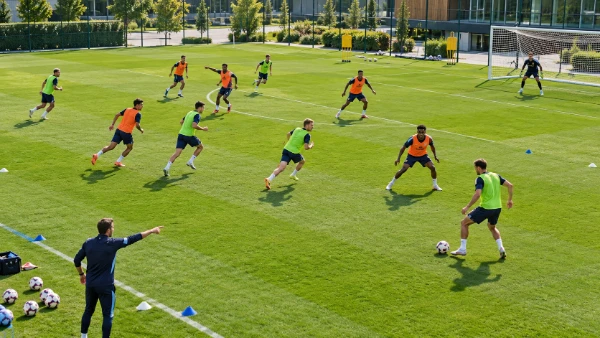
For coaches, the practical value is strongest when tracking analysis leads back to recognisable match situations. Instead of telling a player that the team’s compactness score was poor, an analyst can show five possessions in which the distance between midfield and defence opened as the press moved forward. Instead of presenting a striker with a sprint total, staff can separate runs that attacked a critical area from runs made when the passer had no realistic route forward. Instead of judging a full-back only by tackles, they can review whether his position protected the channel while the opposite side attacked. These are teachable details. They can become constraints in training games, cues in opposition preparation or checkpoints in post-match review. The 2026 research does not suggest that coaches need more dashboards. It suggests that movement data is useful when it helps explain a football problem in language that players and staff can act on.
There are also firm limits to what the 7,705-match evidence can support. The 32 studies used different definitions, samples and models, and the review notes that many analyses were tied to specific contexts. European competitions were prominent, and some individual studies focused on a single league, season or national team. Measures such as pressure, pitch control, compactness and run value can also be calculated in different ways. A model may identify an association without proving why it occurred. The MLS high-speed-run study, for example, found that multiple concurrent runs were linked with higher attacking value, but the authors could not establish whether the runs created the dangerous moment or whether players accelerated because a dangerous moment was already developing. These distinctions are not weaknesses to hide. They are part of using the evidence responsibly. Football is an interactive game in which the same movement can be useful against one opponent and harmful against another.
What has changed by 2026 is the level of detail with which the game away from the ball can be discussed. The strongest research does not say that one formation, one pressing height or one running target is best. It shows that useful tactics are relational. Attackers create value by manipulating defenders and coordinating movements; defenders reduce danger by controlling access, depth and space; teams prepare for transitions before possession has actually changed. Tracking data makes these relationships easier to measure, but interpretation still depends on the football question being asked. For supporters, it offers a richer way to watch a match: the decisive action may be a run that receives no pass, a defender who never makes a tackle or a midfielder who moves three metres to close a lane. For coaches and analysts, the central lesson is equally simple. The ball records the event, but the players around it often explain why that event became possible.