
Women’s Football Calendar in 2026: International Tournaments and Qualification Cycles
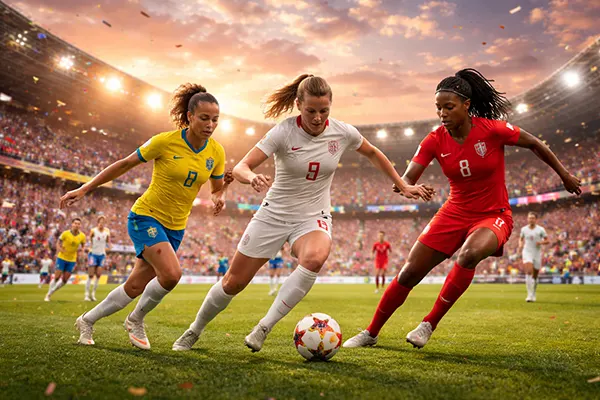
The 2026 season in women’s football is shaped by a dense international schedule that combines continental competitions, global qualification cycles and preparation tournaments for future championships. National teams across Europe, Asia, Africa and the Americas use this year to compete in decisive qualification matches and international tournaments that influence rankings, squad development and long-term strategic planning. Unlike years dominated by major finals such as the FIFA Women’s World Cup or the UEFA Women’s Euro, the 2026 calendar focuses heavily on qualification campaigns and regional championships that determine participation in the next global events.
Global Structure of the Women’s International Football Season in 2026
International women’s football operates according to the official FIFA match calendar, which allocates specific windows for national team fixtures throughout the year. In 2026 these windows allow federations to organise qualification matches for the 2027 FIFA Women’s World Cup and several continental competitions. The schedule ensures that domestic leagues pause during international breaks so national teams can assemble their strongest squads.
One of the most important elements shaping the 2026 calendar is the qualification process for the 2027 Women’s World Cup, which will take place in Brazil. Confederations organise their own qualifying systems, meaning that teams from UEFA, CONMEBOL, CAF, AFC and CONCACAF follow different formats while aiming for the same global tournament.
These qualification stages are not only about securing tournament places. They also determine FIFA rankings, influence seedings for future competitions and give emerging football nations an opportunity to test themselves against stronger opponents.
FIFA International Windows and Their Importance
FIFA schedules several official international windows each year, typically spread across February, April, June, October and November. During these periods clubs must release players to represent their national teams. This system allows coaches to organise qualification matches, friendlies and regional tournaments without conflicts with domestic competitions.
In 2026 these windows are particularly significant because many confederations schedule key qualification rounds within them. Teams often play two matches per window, creating a rhythm similar to the men’s qualification cycles used for major tournaments.
For national team staff the limited number of windows also means that preparation time is restricted. Each match therefore becomes tactically important, especially for countries competing for limited qualification spots.
Major Continental Competitions Influencing the 2026 Calendar
Although 2026 is not the year of a FIFA Women’s World Cup or a UEFA Women’s Euro final tournament, several continental competitions still play an essential role in shaping the season. These tournaments function both as independent championships and as qualification pathways for global events.
In Africa the Women’s Africa Cup of Nations qualification rounds continue during this period. The tournament serves as the primary pathway for African teams aiming to reach the next Women’s World Cup. Strong football nations such as Nigeria, South Africa and Morocco typically dominate the early stages, though recent years have seen rapid development in several emerging teams.
In Asia, qualification tournaments organised by the Asian Football Confederation determine which teams advance to later continental competitions and ultimately to World Cup qualification rounds. Countries including Japan, Australia, China and South Korea remain key contenders in the region.
Regional Championships and Their Competitive Role
Regional competitions across the Americas also shape the 2026 calendar. In South America, CONMEBOL continues its qualification cycle that ultimately leads to the Women’s World Cup. Teams such as Brazil, Colombia and Argentina compete regularly during FIFA windows as the continent prepares for its qualification tournament format.
In North and Central America the CONCACAF Women’s Championship qualification structure continues to develop. The region’s strongest teams, including the United States and Canada, participate in qualification rounds and international tournaments designed to maintain competitive balance across the confederation.
These regional competitions help strengthen women’s football infrastructure by increasing the number of official matches played between national teams. For developing federations, the opportunity to compete regularly at international level is essential for improving tactical organisation and player experience.

European Qualification Campaigns and Competitive Balance
Europe remains one of the most competitive regions in women’s football, and the UEFA qualification system plays a central role in the 2026 international calendar. The UEFA Women’s Nations League and World Cup qualification groups determine which teams advance to major tournaments and which nations move between competition tiers.
Strong national teams such as England, Spain, Germany and France continue to compete at the highest level of the European system, while several emerging teams from Scandinavia, Eastern Europe and the Balkans have become increasingly competitive. The structured league system introduced by UEFA ensures that teams face opponents of comparable strength.
This competitive balance has significantly improved the quality of European women’s football. Matches between mid-ranked nations now often produce close results, demonstrating the growing depth of talent across the continent.
Preparation Matches and Squad Development Before Major Tournaments
Beyond official qualification matches, 2026 also includes numerous international friendlies organised within FIFA windows. These matches allow national team coaches to experiment with tactical systems and integrate younger players into senior squads.
For leading football nations, friendlies often serve as preparation for upcoming global tournaments scheduled for 2027 and beyond. Coaches monitor player fitness, evaluate partnerships between experienced leaders and new talents, and test alternative formations against international opponents.
The long-term effect of these preparation matches is often underestimated. They provide valuable competitive experience and help national teams maintain continuity between major championships, ensuring that the overall level of women’s football continues to grow worldwide.