
Football 2026: How World Cup prep reshapes workload, rotation and injury risks
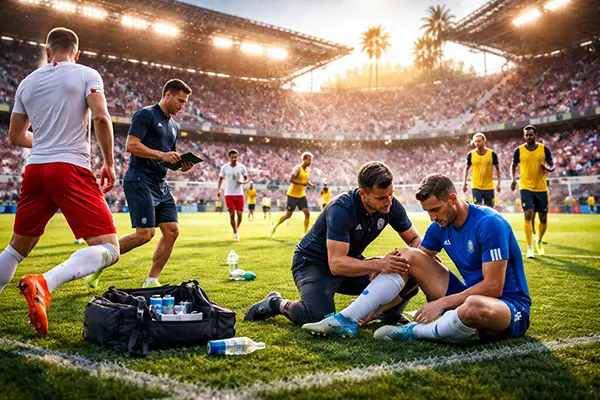
By 2026, “load management” is no longer a buzzword in elite football. The build-up to the FIFA World Cup in Canada, Mexico and the USA creates a season where minutes, travel and recovery time become as decisive as tactics. With the tournament scheduled to start on 11 June 2026 and finish on 19 July 2026, clubs and national teams are trying to keep players sharp without pushing them into predictable injury traps.
Why the road to World Cup 2026 makes fatigue harder to hide
The most obvious change is volume. The 2026 World Cup expands to 48 teams and 104 matches, which increases the overall competitive footprint of the summer and the number of squads planning long camps, long-haul flights and multi-city logistics. That matters even for players who do not reach the latter rounds, because the preparation phase still compresses club timelines and forces earlier, more intense national-team work.
The calendar pressure did not begin in June 2026. FIFA’s 32-team Club World Cup in the USA (June–July 2025) adds another heavy peak in the year before the World Cup, which is exactly when many national-team staff want players building resilience rather than merely surviving matches. In practical terms, some squads go from a long club season into a summer tournament, then return with a shorter off-season and a quicker ramp back to high-intensity work.
Another factor is climate management. FIFA has confirmed mandatory hydration breaks in every 2026 World Cup match, with play stopped around 22 minutes into each half, regardless of conditions. That decision is a player-welfare signal, but it also reflects the reality that heat and dehydration risks can shape performance and cramp recovery plans across a tournament hosted in varied climates.
What changes inside a club week when the World Cup is close
You see more deliberate “micro-rotation”: not just resting a star for a cup tie, but planning minute ceilings across two or three matches. Instead of the old pattern (train hard, play, recover), many teams run a cycle of targeted intensity: fewer maximal sessions, more technical-tactical work at controlled speeds, and carefully chosen spikes (for example, a short but sharp session 72 hours after a match) to keep neuromuscular readiness.
Medical teams also become stricter about the difference between “available” and “ready”. A player can pass basic fitness tests and still be in a high-risk state if travel, sleep disruption and accumulated high-speed running have piled up. That is why you see more monitoring of repeated sprint exposures, deceleration loads and subjective fatigue, with staff prepared to adjust training even if the player feels fine.
Finally, clubs are more open about using squad depth as a protective tool. The closer it gets to June 2026, the more coaches accept that a slightly less cohesive XI in April can be the price of having key players intact in May. The main shift is cultural: rotation becomes a performance strategy, not an apology for weak depth.
Rotation in 2026: the line between smart planning and performance loss
Rotation is not automatically “good”; it has to be structured. Too much chopping and changing can reduce match rhythm, while too little increases overload risk. The sweet spot tends to be planned variation: keeping core partnerships stable, but rotating high-load roles (full-backs who sprint repeatedly, wingers who stack accelerations, and pressing midfielders) more aggressively than positions with steadier running profiles.
Travel and international duty complicate that plan. A player returning from a long flight and a high-stakes qualifier may be technically fit yet physiologically depleted, especially if their match included a lot of high-speed running or repeated decelerations. In 2026, the best staffs treat travel as a training stressor in its own right and factor it into selection and the week’s intensity budget.
Rotation also changes because national-team coaches want players arriving in camp with freshness, not just form. That creates subtle tension: clubs want results, players want to play, and national teams want healthy starters. The compromise is usually negotiated in minutes and roles, not in headlines.
Practical rotation rules that reduce injury risk without dulling intensity
First, teams protect the “red zones”: the days when muscle injuries cluster. Commonly, that is the second match in a short span (for example, three games in eight days) and the first start after a long flight. A practical solution is to reduce the minutes of players in sprint-heavy roles on those days, rather than resting them only when they complain of tightness.
Second, clubs increasingly pre-plan substitutions. If a winger is repeatedly asked to produce late-game sprints, their hamstring risk rises when fatigue hits. Planning a 60–70 minute window for certain profiles keeps intensity high early, then hands the late sprinting burden to a fresher player rather than asking one body to do both jobs.
Third, rotation works best when it is paired with role clarity. Asking a rotated-in player to copy every movement of the starter can backfire. Coaches who lower pressing volume, adjust build-up routes, or change the full-back’s overlap demands for that match often get the same result with less peak load.
Injury risk in the WC 2026 build-up: what is most likely to go wrong
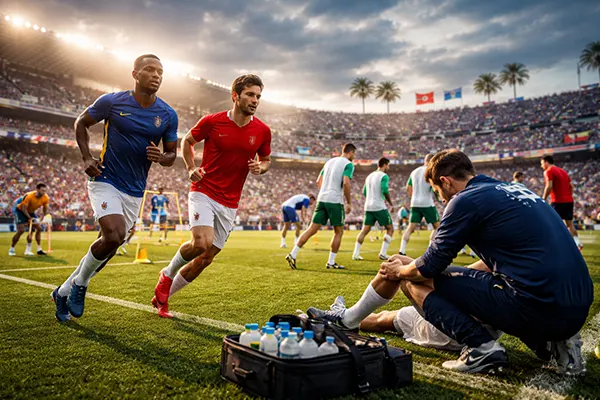
The classic danger is soft-tissue injuries after congestion: hamstrings, calves and adductors. These are not only “sprinting injuries”; they are often the end product of accumulated fatigue plus one uncontrolled action. When squads are chasing league points while players are also thinking about June 2026, decision-making can become cautious, and that split focus sometimes leads to poor movement choices under pressure.
Another growing concern is overload injuries that are less dramatic but equally disruptive: tendon pain, hip issues and lower-back problems. They often appear when recovery windows shrink and training becomes “maintenance” rather than progressive conditioning. If strength work is reduced too far, tissue capacity drops; if it is kept too heavy, players do not recover. In 2026, the difference is often found in careful dosing rather than in a single magic exercise.
Then there are the environmental and match-rhythm factors. The mandatory hydration breaks in every World Cup match change the pattern of effort, almost like forced mini-resets. That may help with heat strain, but it can also create sharper re-start moments where players sprint immediately after a pause, which is exactly when cold-ish muscles and poor readiness can trigger strains if warm-up routines are sloppy.
How clubs and national teams actually reduce injuries in 2026
They protect speed, not avoid it. The mistake is removing sprinting from training to “save legs”, then asking for maximal speed in matches. Better practice is controlled exposure: short, well-timed sprint sets in training, plus planned high-speed runs for players returning from injury or from reduced minutes, so match demands are not a shock.
They treat sleep and travel recovery as non-negotiable performance work. That means earlier travel, structured light exposure, hydration routines, and simple but consistent post-flight sessions that restore circulation and movement quality. It is not glamorous, yet it often prevents the “dead legs” feeling that precedes poor mechanics and late-reacting tackles.
And they coordinate more than before. Players’ unions have repeatedly highlighted that expansion of competitions increases risk and strains recovery, which is why clubs, national teams and medical departments are forced into clearer communication in the WC 2026 cycle. When that coordination works, the player is less likely to be pulled in three directions at once—and far more likely to arrive in June healthy and genuinely match-ready.